

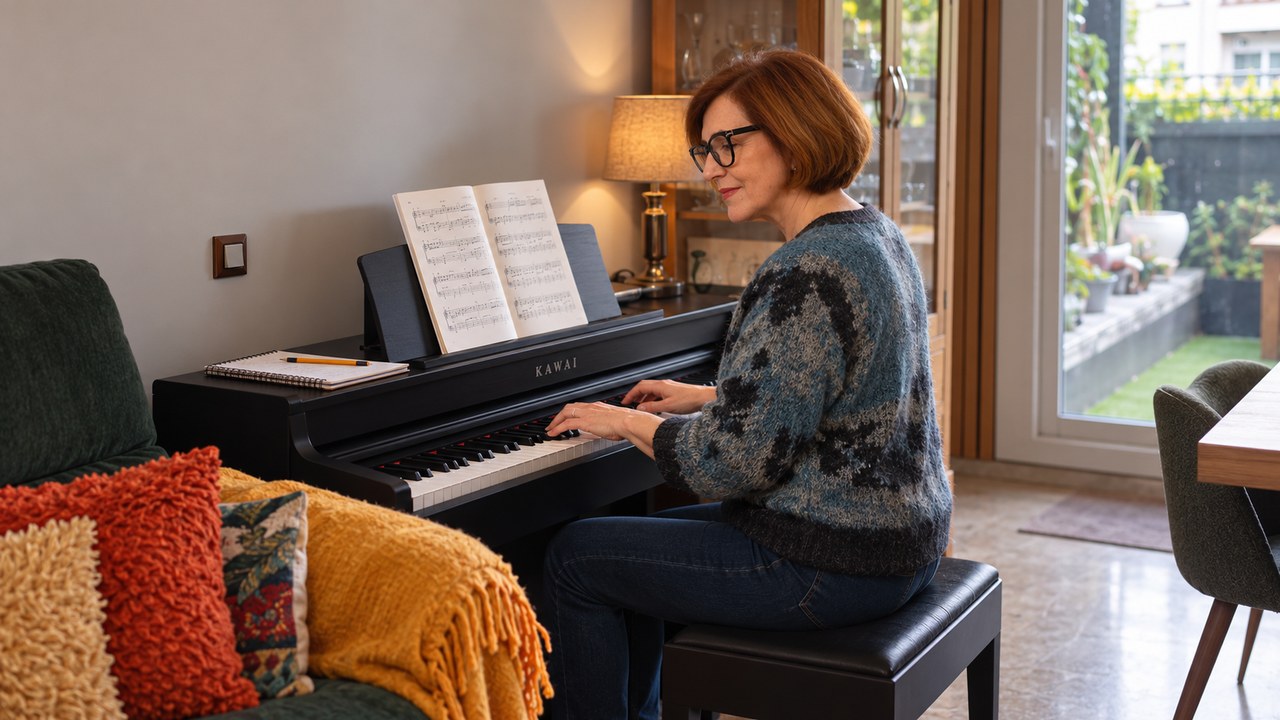
You want to practise, but the day fills up. Work runs late, homework takes longer than expected, or you finally have a quiet moment and feel too tired to begin.
If that sounds familiar, it may help to make your practice routine a little simpler. You don’t need to cover everything each time you sit at the piano. Knowing what you want to work on can make a short session feel more manageable and worthwhile.
Find a moment that suits your day
Think about when practice might fit comfortably into your usual routine. Perhaps there is a little time after breakfast, before the evening meal or once the house is quieter.
A familiar moment can make it easier to remember, but leave some flexibility. A routine should help you return to the piano, even when the week doesn’t go quite as planned.
Keep your music ready, along with any notes from your lesson. When you have a few minutes available, it helps to know where to begin.
Start with something familiar
You don’t always have to begin with the most difficult part of your music.
Try playing a short passage you know reasonably well. Listen to the sound, let your hands settle and give yourself a moment to enjoy being at the piano.
Then turn to the part that needs more attention.
Choose one small goal
“Practise my piece” can feel like a large task. A more specific goal gives you something clear to work towards.
You might decide to:
- Find a comfortable fingering for a few notes.
- Understand a rhythm that keeps interrupting the flow.
- Move more smoothly between two hand positions.
- Shape the ending of a phrase more gently.
Choose a short section and work slowly enough to notice what is happening. If the same difficulty keeps returning, make the section smaller or try one hand at a time, where appropriate.
Once it feels more comfortable, add a little music before and after it. This helps you practise moving into and out of the passage, as well as playing the notes themselves.
There is no need to solve every difficulty in one sitting. Bring anything that remains confusing to your next lesson so we can work through it together.
Leave time to enjoy the music
It is easy to spend a whole practice session correcting things and forget why you wanted to play in the first place.
Before you finish, return to something you enjoy. It might be a familiar piece, a favourite phrase or the section you have just worked on.
Listen for a small change. Perhaps a movement feels easier, the rhythm is clearer or you can hear the melody more naturally. Noticing these details can help you recognise progress that might otherwise pass unnoticed.
Have a shorter option for busy days
Some days will offer less time or energy than others. It helps to have a simple option ready.
You could play a familiar passage, spend a few minutes on one awkward transition and finish with something you enjoy. At your next session, revisit that transition and see how it feels.
If you miss a day, begin again when you can. You don’t need to make the next session longer to compensate.
Supporting a child’s practice
For children, a gentle reminder and a clear starting point can make practice easier to begin.
Rather than asking them to “practise everything”, help them find the task agreed in their lesson. You might ask, “Which part were you going to work on today?” or invite them to show you something they have learnt.
Give them space to try things and notice their own progress. If practice repeatedly becomes frustrating, let me know. We can look at what is causing the difficulty and make the task more manageable.
Find a routine that works for you
Adults often fit piano around work, family and other responsibilities. Children have busy weeks too. A useful practice routine takes those commitments into account.
The aim is to arrive at the piano with a clear idea, give something your attention and leave with a reason to return.
If you are unsure how to organise your practice between lessons, we can talk it through together. Sometimes, choosing a smaller and clearer task is all you need to get started.




Leave A Comment