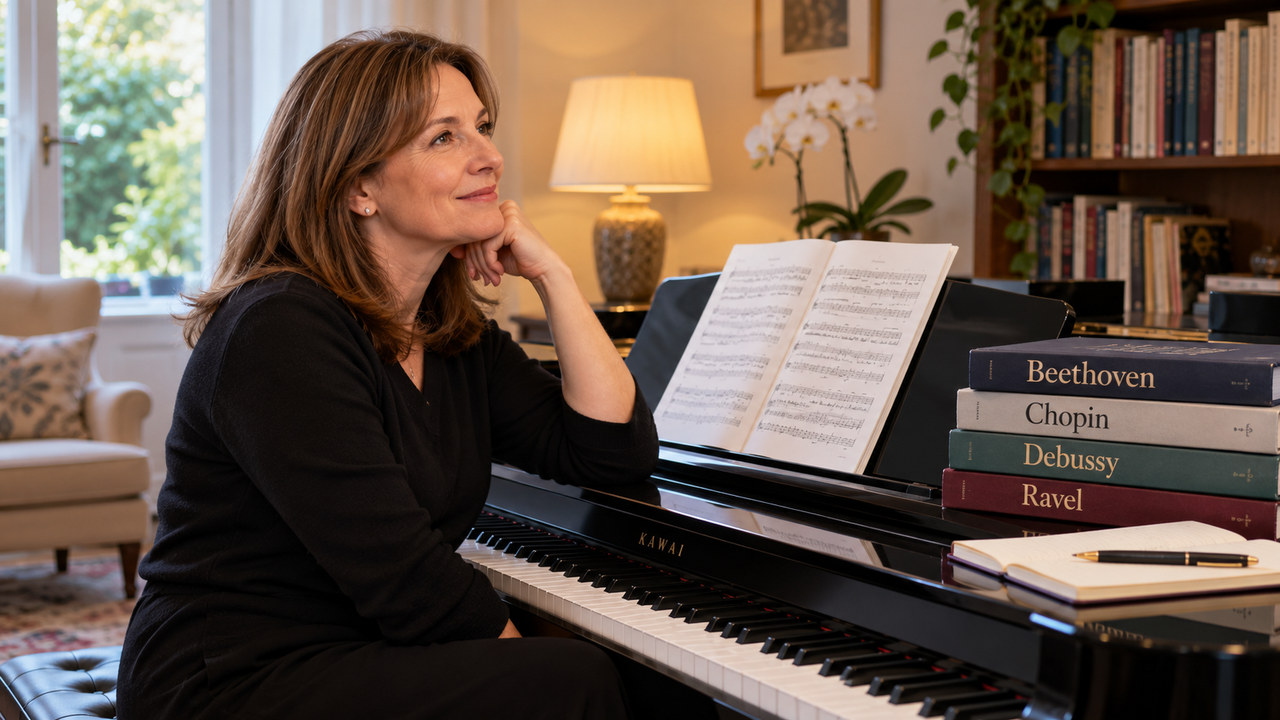
Passing ABRSM Grade 8 is a wonderful achievement. It represents years of dedication, practice and musical development, and reaching this level is something every pianist should be proud of.
But one question I sometimes hear is: What happens after Grade 8?
The answer is that there is still an enormous amount to discover. Grade 8 is not the end of learning the piano. For many musicians, it is the beginning of a particularly rewarding stage, when they can explore more demanding repertoire, develop greater independence and begin to discover their own musical voice.
For pianists who enjoy working towards examinations, ABRSM offers three advanced Music Performance diplomas: ARSM, LRSM and FRSM. However, examinations are not the only way forward. There are many reasons to continue studying the piano, whether or not another qualification is your ultimate goal.
What changes after Grade 8?
During the graded examination years, students gradually develop their technique, sight-reading, listening skills and musical understanding. Each grade introduces new challenges and provides a structure for learning.
Beyond Grade 8, the emphasis begins to change.
Technical accuracy remains essential, of course, but advanced piano playing requires much more than being able to play difficult notes. Pianists need to develop their interpretation, understand the structure and character of the music, and communicate their musical ideas convincingly.
They must also learn to take greater responsibility for their own playing.
For example, two pianists might perform the same Chopin nocturne with equally accurate notes and rhythms, yet produce very different musical results. The way they shape phrases, balance the melody and accompaniment, use the pedal and manage expressive freedom can make an enormous difference.
These are skills that develop through careful listening, thoughtful practice and experience. They are also some of the most interesting aspects of advanced piano study.
Understanding the ABRSM Music Performance diplomas
ABRSM offers three levels of Music Performance diploma beyond Grade 8. Each provides an opportunity to demonstrate increasingly advanced performing skills and musical understanding.
ARSM – Associate of the Royal Schools of Music
The ARSM is often a natural next step for a pianist who has completed Grade 8 and would like to continue working towards a recognised qualification.
Candidates prepare a balanced programme of music lasting approximately 30 minutes. At least 20 minutes must be selected from the prescribed ARSM repertoire list, with the remaining time available for suitable own-choice music.
Unlike the traditional practical grades, there are no scales, sight-reading or aural tests in the ARSM examination. The assessment concentrates entirely on the musical performance.
However, this does not necessarily make the diploma easier. Preparing a complete programme requires considerable stamina, concentration and consistency.
Students must learn to maintain musical quality throughout the performance rather than concentrating on three or four relatively short examination pieces.
For many pianists, ARSM provides an excellent opportunity to develop the confidence and independence needed for more advanced musical study.
LRSM – Licentiate of the Royal Schools of Music
The LRSM represents a significant step forward in both technical and musical demands.
Candidates prepare a performance programme of approximately 45 minutes, requiring a broader range of repertoire and greater interpretative maturity.
The LRSM also includes a second component called Performance in Context. Candidates submit written or recorded spoken evidence exploring an aspect of their music or performance.
This encourages musicians to think more deeply about their artistic decisions and demonstrate an understanding of the music beyond the physical act of playing it.
At this level, simply mastering difficult passages is not enough. The pianist needs to communicate a convincing musical interpretation, understand stylistic differences and maintain concentration throughout an extended performance.
Preparation therefore involves not only learning the repertoire but also studying its musical background, structure and expressive possibilities.
FRSM – Fellowship of the Royal Schools of Music
The FRSM is the most advanced of the three Music Performance diplomas.
It requires a programme of approximately 55 minutes, demonstrating a very high standard of technical command, musical maturity and artistic communication.
Alongside the performance, candidates complete a substantial Research and Reflection component, presented through written work or a recorded spoken submission.
At this level, performers are expected to demonstrate considerable independence in their musical decisions and an advanced understanding of their chosen repertoire.
Preparing for FRSM is a major undertaking, requiring sustained commitment and carefully structured study.
It can also be an exceptionally rewarding musical challenge for a pianist who enjoys exploring demanding repertoire in considerable depth.
Do you have to take the diplomas in order?
Not necessarily.
Although ARSM, LRSM and FRSM form a natural progression, ABRSM does not require candidates to pass each diploma before attempting the next.
The normal entry requirement is Grade 8 in the relevant instrument, although certain equivalent qualifications and alternative routes may be accepted.
However, meeting the entry requirements and being musically ready are two different things.
A pianist who has recently passed Grade 8 may benefit greatly from spending time developing a wider repertoire and strengthening their technique before beginning a diploma.
Others may already have considerable performing experience and be ready for a more advanced challenge.
I believe the most important consideration is choosing a goal that suits the individual pianist, rather than feeling pressure to progress through qualifications as quickly as possible.
How should you prepare for a piano performance diploma?
Preparing for a diploma requires a slightly different approach from preparing for a graded examination.
Choosing the right repertoire is one of the most important decisions. A successful programme should demonstrate musical variety and technical ability, but it must also suit the pianist’s individual strengths.
Choosing the most difficult pieces is not necessarily the best strategy. Music that allows a pianist to communicate convincingly will often make a stronger impression than repertoire that stretches their technique beyond what they can comfortably control.
Developing musical interpretation also becomes increasingly important. Understanding the composer’s style, the structure of a work and the relationship between musical ideas can help transform an accurate performance into a convincing one.
Building stamina and consistency is another essential part of preparation. Playing a complete programme requires a different kind of concentration from practising individual passages.
I recommend gradually introducing complete performances into the practice routine, recording them occasionally and listening critically afterwards.
It is important to identify not only technical mistakes but also moments when the musical direction becomes unclear, the tempo loses stability or concentration begins to suffer.
At LRSM and FRSM levels, preparation also needs to include time for the supporting written or spoken component. This should develop alongside the practical work rather than being treated as an afterthought.
A good teacher can help structure this process, identify areas requiring attention and ensure that technical development and musical interpretation progress together.
Do you need another examination to keep improving?
Absolutely not!
One of the pleasures of reaching an advanced level is having greater freedom to explore music simply because you enjoy it.
Perhaps you have always wanted to learn a particular Beethoven sonata, explore the works of Debussy or Ravel, or return to a piece you studied years ago with a fresh understanding.
You might wish to improve your sight-reading, develop a more refined piano technique or become more confident performing for friends and family.
All of these are worthwhile musical goals.
I have always believed that examinations should support musical development rather than become the sole reason for learning an instrument.
A qualification can provide motivation and a useful structure, but the lasting reward comes from becoming a more capable, expressive and independent musician.
Advanced piano lessons and diploma preparation with Anna Peszko
With over 40 years of piano teaching experience, I understand that every pianist has different strengths, interests and ambitions.
I offer tuition for experienced pianists who wish to prepare for ABRSM Music Performance diplomas at ARSM, LRSM and FRSM levels, as well as those who simply want to continue improving their playing beyond Grade 8.
My approach is to consider each student’s existing technique, musical understanding and repertoire before deciding on the most suitable way forward.
Lessons can focus on repertoire selection, technical development, interpretation, effective practice and preparation for an extended performance programme.
I also offer online piano lessons for experienced students, including those who have already completed their graded examinations.
If you are currently preparing for Grade 8, you may also find my guide to the ABRSM Piano Grade 8 syllabus for 2027–2028 helpful.
Your musical journey continues
Whether you decide to work towards ARSM, LRSM or FRSM, explore more advanced repertoire or simply enjoy playing the piano at a higher level, there is always something new to learn.
Grade 8 is a significant milestone, but it does not have to be your final destination.
The most important thing is to maintain your curiosity, enjoy discovering new music and continue developing your abilities at a pace that suits you.
If you would like to discuss diploma preparation or advanced piano lessons, please get in touch. I would be very happy to hear about your playing and what you would like to achieve next.